HSC Resources · Physics Homework Notes
Ch08 Periodic Motion
Lecture slides and notes for Ch08 Periodic Motion from the Physics Homework Notes module in HSC Resources by Md Ahbab. 14 pages.
Content Preview
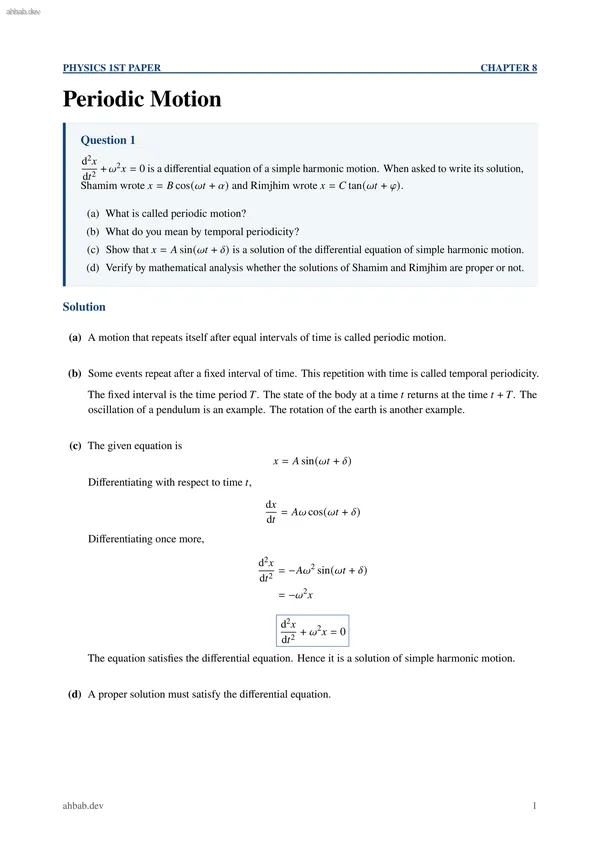
PHYSICS 1ST PAPER CHAPTER 8 Periodic Motion Question 1 d2𝑥 d𝑡2 + 𝜔2𝑥= 0 is a differential equation of a simple harmonic motion. When asked to write its solution, Shamim wrote 𝑥= 𝐵cos(𝜔𝑡+ 𝛼) and Rimjhim wrote 𝑥= 𝐶tan(𝜔𝑡+ 𝜑). (a) What is called periodic motion? (b) What do you mean by temporal periodicity? (c) Show that 𝑥= 𝐴sin(𝜔𝑡+ 𝛿) is a solution of the differential equation of simple harmonic motion. (d) Verify by mathematical analysis whether the solutions of Shamim and Rimjhim are proper or not. Solution (a) A motion that repeats itself after equal intervals of time is called periodic motion. (b) Some events repeat after a fixed interval of time. This repetition with time is called temporal periodicity. The fixed interval is the time period 𝑇. The state of the body at a time 𝑡returns at the time 𝑡+ 𝑇. The oscillation of a pendulum is an example. The rotation of the earth is another example. (c) The given equation is 𝑥= 𝐴sin(𝜔𝑡+ 𝛿) Differentiating with respect to time 𝑡, d𝑥 d𝑡= 𝐴𝜔cos(𝜔𝑡+ 𝛿) Differentiating once more, d2𝑥 d𝑡2 = −𝐴𝜔2 sin(𝜔𝑡+ 𝛿) = −𝜔2𝑥 d2𝑥 d𝑡2 + 𝜔2𝑥= 0 The equation satisfies the differential equation. Hence it is a solution of simple harmonic motion. (d) A proper so
Solution of Shamim. Here 𝑥= 𝐵cos(𝜔𝑡+ 𝛼). d𝑥 d𝑡= −𝐵𝜔sin(𝜔𝑡+ 𝛼) d2𝑥 d𝑡2 = −𝐵𝜔2 cos(𝜔𝑡+ 𝛼) = −𝜔2𝑥 d2𝑥 d𝑡2 + 𝜔2𝑥= 0 This solution satisfies the differential equation. Solution of Rimjhim. Here 𝑥= 𝐶tan(𝜔𝑡+ 𝜑). d𝑥 d𝑡= 𝐶𝜔sec2(𝜔𝑡+ 𝜑) d2𝑥 d𝑡2 = 2𝐶𝜔2 sec2(𝜔𝑡+ 𝜑) tan(𝜔𝑡+ 𝜑) = 2𝜔2𝑥sec2(𝜔𝑡+ 𝜑) The right side is not equal to −𝜔2𝑥. This solution does not satisfy the differential equation. 𝜋 2𝜋 3𝜋 4𝜋 −𝐵 𝐵 cosine tangent 𝜔𝑡 𝑥 The cosine curve stays between −𝐵and +𝐵. The tangent curve becomes infinite again and again. A real oscillating body cannot have an infinite displacement. The solution of Shamim is proper. The solution of Rimjhim is not proper. ahbab.dev 2
Question 2 A particle is revolving around the point 𝑂in a circular path 𝐴𝐵𝐶𝐷of radius 0.02 m along the clockwise direction with an angular velocity 1 rad s−1 and in 10 s it comes to 𝑃from 𝐴. 𝑋 𝑌 𝐴 𝐵 𝐶 𝐷 𝑂 𝑃 𝑁 𝜃 𝜃 𝜔 𝑥 (a) What is called simple harmonic motion? (b) Explain the relation of force constant and mass in case of a spring. (c) Deduce the differential equation of the motion along the 𝑋-axis of the particle of the stimulus. (d) If the initial phase of the particle is 0, then what is the displacement at 𝑃along the 𝑋-axis? Solution (a) In simple harmonic motion, the acceleration is proportional to the displacement. It is always directed towards the equilibrium position. (b) Let a body of mass 𝑚oscillate on a spring of force constant 𝑘. 𝜔= √︂ 𝑘 𝑚, 𝑇= 2𝜋 √︂𝑚 𝑘 A larger force constant means a stiffer spring. The restoring force is then greater and the time period is smaller. A larger mass has more inertia. The time period is then greater. For a fixed time period, 𝑘is proportional to 𝑚. (c) Let the radius of the circle be 𝑅. The particle starts from 𝐴and moves clockwise. In a time 𝑡it turns through an angle 𝜃= 𝜔𝑡from 𝑂𝐴. The foot of the perpendicular from 𝑃on the 𝑋-axis is 𝑁. In th
11 further pages require an access key.
The pages above are free to read. The rest of this document is available to people holding a key issued by the author.