HSC Resources · Physics Homework Notes
Ch05 Work Energy and Power
Lecture slides and notes for Ch05 Work Energy and Power from the Physics Homework Notes module in HSC Resources by Md Ahbab. 14 pages.
Content Preview
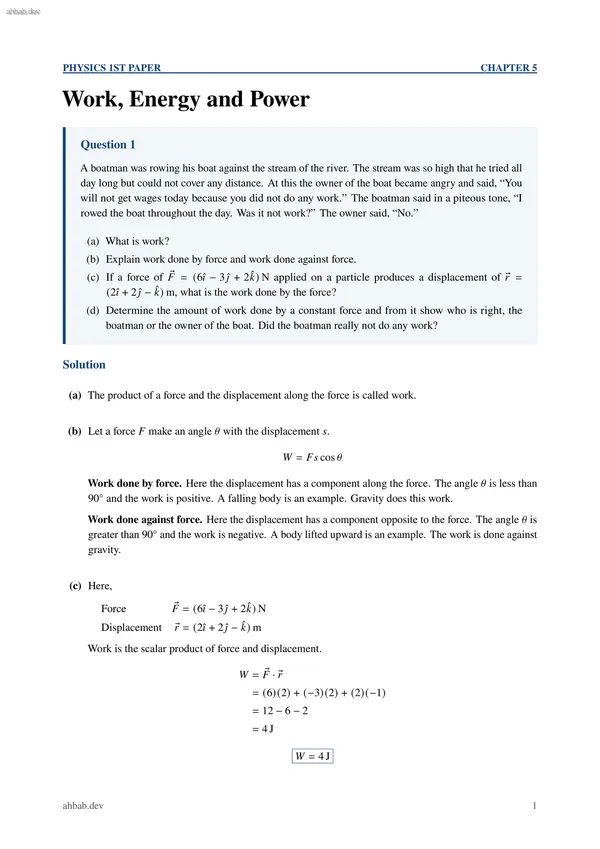
PHYSICS 1ST PAPER CHAPTER 5 Work, Energy and Power Question 1 A boatman was rowing his boat against the stream of the river. The stream was so high that he tried all day long but could not cover any distance. At this the owner of the boat became angry and said, “You will not get wages today because you did not do any work.” The boatman said in a piteous tone, “I rowed the boat throughout the day. Was it not work?” The owner said, “No.” (a) What is work? (b) Explain work done by force and work done against force. (c) If a force of ®𝐹= (6ˆ𝚤−3 ˆ𝚥+ 2ˆ𝑘) N applied on a particle produces a displacement of ®𝑟= (2ˆ𝚤+ 2 ˆ𝚥−ˆ𝑘) m, what is the work done by the force? (d) Determine the amount of work done by a constant force and from it show who is right, the boatman or the owner of the boat. Did the boatman really not do any work? Solution (a) The product of a force and the displacement along the force is called work. (b) Let a force 𝐹make an angle 𝜃with the displacement 𝑠. 𝑊= 𝐹𝑠cos 𝜃 Work done by force. Here the displacement has a component along the force. The angle 𝜃is less than 90◦and the work is positive. A falling body is an example. Gravity does this work. Work done against force. Here
(d) Work done by a constant force. Let a constant force 𝐹act on a body. The force makes an angle 𝜃with the displacement 𝑠. 𝐹 𝐹cos 𝜃 𝜃 𝑠 Only the component 𝐹cos 𝜃acts along the displacement. The work done is 𝑊= (𝐹cos 𝜃) 𝑠= 𝐹𝑠cos 𝜃= ®𝐹· ®𝑠 The case of the boatman. The boatman applied a force all day. However, the boat did not move with respect to the bank. force of the boatman stream displacement of the boat, 𝑠= 0 𝑊= 𝐹𝑠cos 𝜃 = 𝐹× 0 × cos 𝜃 = 0 𝑊= 0 The work done on the boat is zero in the sense of physics. Hence the owner is right. The boatman spent energy and became tired. That effort only pushed the water backward. It produced no displacement of the boat. ahbab.dev 2
Question 2 The spring constant of a spring is 100 N m−1. One end of the spring is attached to a rigid support. The spring can be extended or compressed. (a) What is called elastic force? (b) What do you mean by the statement that the spring constant of a spring is 100 N m−1? (c) How much work is to be done to extend the spring by 2 cm against the spring force? (d) Show mathematically that the same amount of work is done against the spring force in extending or compressing the free end of the spring by the same amount. Solution (a) The force that restores the original shape of a deformed body is called elastic force. (b) The spring force is proportional to the change in length of the spring. 𝐹= 𝑘𝑥 Here 𝑘is the spring constant. For 𝑥= 1 m the force is 𝐹= 𝑘. Hence a force of 100 N is needed to extend the spring by 1 m. The same force is needed to compress it by 1 m. (c) Here, Spring constant 𝑘= 100 N m−1 Extension 𝑥= 2 cm = 0.02 m 𝑥 𝐹= 𝑘𝑥 𝑥 𝐹 𝑥 𝑘𝑥 𝑊= 1 2 𝑘𝑥2 The applied force 𝐹= 𝑘𝑥changes with the extension. The work is found by integration. 𝑊= ∫ 𝑥 0 𝑘𝑥d𝑥= 1 2 𝑘𝑥2 = 1 2 × 100 × (0.02)2 J = 0.02 J 𝑊= 0.02 J (d) Let the free end be moved by an amount 𝑥in each case. ahbab.dev 3
11 further pages require an access key.
The pages above are free to read. The rest of this document is available to people holding a key issued by the author.