HSC Resources · Physics Homework Notes
Ch06 Gravitation and Gravity
Lecture slides and notes for Ch06 Gravitation and Gravity from the Physics Homework Notes module in HSC Resources by Md Ahbab. 14 pages.
Content Preview
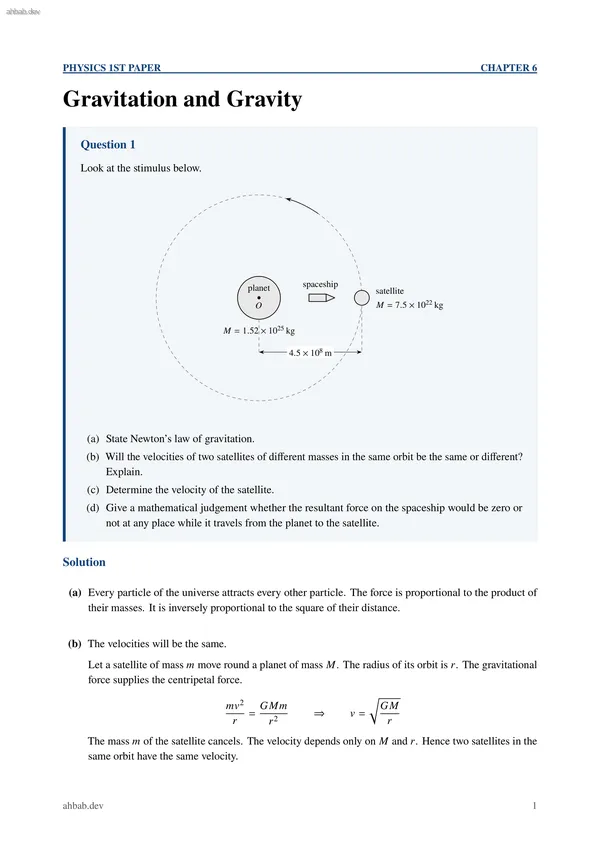
PHYSICS 1ST PAPER CHAPTER 6 Gravitation and Gravity Question 1 Look at the stimulus below. planet 𝑂 𝑀= 1.52 × 1025 kg satellite 𝑀= 7.5 × 10²² kg spaceship 4.5 × 10⁸ m (a) State Newton’s law of gravitation. (b) Will the velocities of two satellites of different masses in the same orbit be the same or different? Explain. (c) Determine the velocity of the satellite. (d) Give a mathematical judgement whether the resultant force on the spaceship would be zero or not at any place while it travels from the planet to the satellite. Solution (a) Every particle of the universe attracts every other particle. The force is proportional to the product of their masses. It is inversely proportional to the square of their distance. (b) The velocities will be the same. Let a satellite of mass 𝑚move round a planet of mass 𝑀. The radius of its orbit is 𝑟. The gravitational force supplies the centripetal force. 𝑚𝑣2 𝑟 = 𝐺𝑀𝑚 𝑟2 ⇒ 𝑣= √︂ 𝐺𝑀 𝑟 The mass 𝑚of the satellite cancels. The velocity depends only on 𝑀and 𝑟. Hence two satellites in the same orbit have the same velocity. ahbab.dev 1
(c) Here, Mass of the planet 𝑀= 1.52 × 1025 kg Radius of the orbit 𝑟= 4.5 × 10⁸ m Gravitational constant 𝐺= 6.673 × 10⁻¹¹ N m2 kg−2 The velocity of the satellite in its orbit is 𝑣= √︂ 𝐺𝑀 𝑟 = √︄ 6.673 × 10−11 × 1.52 × 1025 4.5 × 10⁸ m s−1 = √︁ 2.254 × 10⁶ m s−1 = 1501 m s−1 𝑣= 1.5 km s−1 (d) Let the spaceship have the mass 𝑚0 and the satellite the mass 𝑚. The planet and the satellite pull the spaceship in opposite directions. 𝑀 𝑚 𝑚0 𝐹1 𝐹2 𝑥 𝑟−𝑥 Let the resultant force be zero at a distance 𝑥from the planet. The two pulls are then equal. 𝐺𝑀𝑚0 𝑥2 = 𝐺𝑚𝑚0 (𝑟−𝑥)2 𝑟−𝑥 𝑥 = √︂ 𝑚 𝑀= √︄ 7.5 × 10²² 1.52 × 1025 = 0.0702 𝑟= 1.0702 𝑥 𝑥= 4.5 × 10⁸ 1.0702 m = 4.20 × 10⁸ m The value of 𝑥is positive and less than 𝑟. Hence this point lies on the path of the spaceship. 𝑥= 4.2 × 10⁸ m from the planet The resultant force on the spaceship is zero at this point only. Before this point the pull of the planet is greater. After it the pull of the satellite is greater. ahbab.dev 2
Question 2 The graph shows the variation of the gravitational force 𝐹of the moon on a body of mass 1000 kg with the distance 𝑟from the centre of the moon. 1.75 2.2 3.1 4.3 0.25 0.5 1.0 1.6 radius of the moon 𝑟(×106 m) 𝐹(×103 N) Given, radius of the earth, 𝑅= 6.4 × 10⁶ m, acceleration due to gravity of the earth, 𝑔= 9.8 m s−2 and 𝐺= 6.67 × 10⁻¹¹ N m2 kg−2. (a) What is called centre of gravity? (b) The acceleration due to gravity of an object falling from different heights does not remain uniform. Explain. (c) Determine the mass of the moon using the data of the stimulus. (d) Using the data of the stimulus compare the gravitational forces on the body at heights 2.55×10⁶ m from the earth’s and the moon’s surfaces. Solution (a) The point where the whole weight of a body acts is called centre of gravity. (b) The acceleration due to gravity at a height ℎabove the earth is 𝑔ℎ= 𝐺𝑀 (𝑅+ ℎ)2 Here 𝑀and 𝑅are the mass and radius of the earth. The value of 𝑔ℎdepends on the height ℎ. A falling body comes nearer to the earth, so ℎdecreases. The value of 𝑔ℎtherefore increases during the fall. Hence the acceleration does not remain uniform. (c) From the graph, the force at the surface of the moon is
11 further pages require an access key.
The pages above are free to read. The rest of this document is available to people holding a key issued by the author.