HSC Resources · Physics Homework Notes
Ch03 Dynamics
Lecture slides and notes for Ch03 Dynamics from the Physics Homework Notes module in HSC Resources by Md Ahbab. 14 pages.
Content Preview
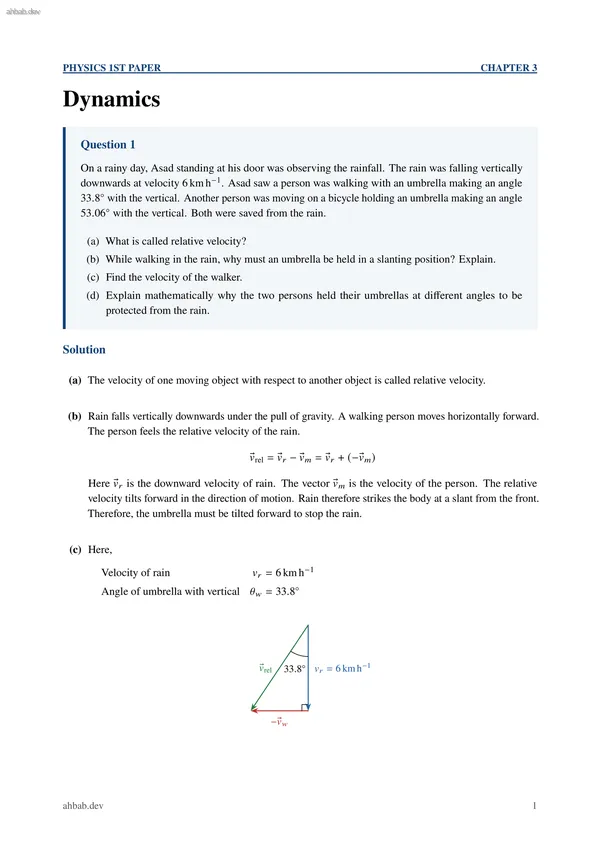
PHYSICS 1ST PAPER CHAPTER 3 Dynamics Question 1 On a rainy day, Asad standing at his door was observing the rainfall. The rain was falling vertically downwards at velocity 6 km h−1. Asad saw a person was walking with an umbrella making an angle 33.8◦with the vertical. Another person was moving on a bicycle holding an umbrella making an angle 53.06◦with the vertical. Both were saved from the rain. (a) What is called relative velocity? (b) While walking in the rain, why must an umbrella be held in a slanting position? Explain. (c) Find the velocity of the walker. (d) Explain mathematically why the two persons held their umbrellas at different angles to be protected from the rain. Solution (a) The velocity of one moving object with respect to another object is called relative velocity. (b) Rain falls vertically downwards under the pull of gravity. A walking person moves horizontally forward. The person feels the relative velocity of the rain. ®𝑣rel = ®𝑣𝑟−®𝑣𝑚= ®𝑣𝑟+ (−®𝑣𝑚) Here ®𝑣𝑟is the downward velocity of rain. The vector ®𝑣𝑚is the velocity of the person. The relative velocity tilts forward in the direction of motion. Rain therefore strikes the body at a slant from the front. Therefo
Let the horizontal velocity of the walker be 𝑣𝑤. From the vector triangle of relative velocity, tan 𝜃𝑤= 𝑣𝑤 𝑣𝑟 𝑣𝑤= 𝑣𝑟tan 𝜃𝑤 = 6 km h−1 × tan 33.8◦ = 6 × 0.6694 km h−1 = 4.02 km h−1 𝑣𝑤= 4.02 km h−1 (d) Let the velocity of the cyclist be 𝑣𝑐. The umbrella angle with the vertical is 𝜃𝑐= 53.06◦. tan 𝜃𝑐= 𝑣𝑐 𝑣𝑟 𝑣𝑐= 𝑣𝑟tan 𝜃𝑐 = 6 km h−1 × tan 53.06◦ = 6 × 1.330 km h−1 = 7.98 km h−1 The umbrella must point along the relative velocity of the rain. The tilt angle 𝜃depends directly on horizontal speed. tan 𝜃= 𝑣 𝑣𝑟 Here 𝑣𝑐> 𝑣𝑤because 7.98 km h−1 > 4.02 km h−1. A higher horizontal speed produces a larger slant angle with the vertical. 𝜃𝑐> 𝜃𝑤 Hence the two persons held their umbrellas at different angles. ahbab.dev 2
Question 2 The graph of velocity versus time of an airplane is given below: 10 20 30 40 50 60 70 80 200 400 𝑡(s) 𝑣(m s−1) (a) What is called average acceleration? (b) What do you understand by instantaneous velocity? (c) What was the acceleration of the airplane to reach from rest to constant velocity? (d) Explain with mathematical argument how long the airplane travelled with a speed greater than that of sound. [Velocity of sound is 340 m s−1.] Solution (a) Total change in velocity divided by the total time taken is called average acceleration. (b) The velocity of a body at a particular instant of time is instantaneous velocity. It is the limiting value of average velocity when the time interval approaches zero. ®𝑣= lim Δ𝑡→0 Δ®𝑟 Δ𝑡= d®𝑟 d𝑡 The magnitude and direction can vary at every point along the path. (c) The airplane accelerates uniformly from rest to 400 m s−1 in the first 20 s. Here, Initial velocity 𝑢= 0 m s−1 Final velocity 𝑣1 = 400 m s−1 Time interval 𝑡1 = 20 s The uniform acceleration during this stage is 𝑎= 𝑣1 −𝑢 𝑡1 = 400 −0 20 m s−2 = 20 m s−2 𝑎= 20 m s−2 (d) The speed of sound is 𝑣𝑠= 340 m s−1. The graph shows when the speed is greater than 𝑣𝑠. ahbab.dev 3
11 further pages require an access key.
The pages above are free to read. The rest of this document is available to people holding a key issued by the author.