HSC Resources · Physics Homework Notes
Ch07 Structural Properties of Matter
Lecture slides and notes for Ch07 Structural Properties of Matter from the Physics Homework Notes module in HSC Resources by Md Ahbab. 14 pages.
Content Preview
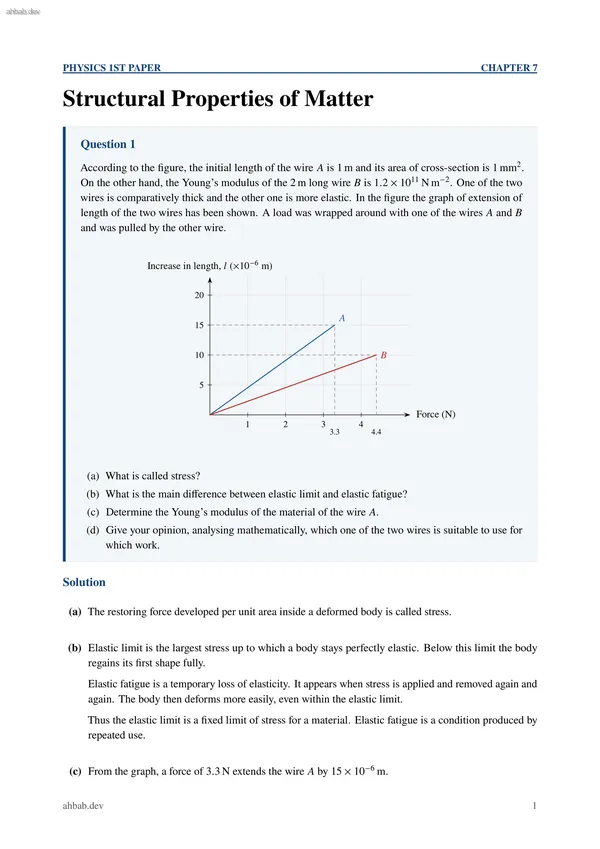
PHYSICS 1ST PAPER CHAPTER 7 Structural Properties of Matter Question 1 According to the figure, the initial length of the wire 𝐴is 1 m and its area of cross-section is 1 mm2. On the other hand, the Young’s modulus of the 2 m long wire 𝐵is 1.2 × 10¹¹ N m−2. One of the two wires is comparatively thick and the other one is more elastic. In the figure the graph of extension of length of the two wires has been shown. A load was wrapped around with one of the wires 𝐴and 𝐵 and was pulled by the other wire. 1 2 3 4 5 10 15 20 𝐴 𝐵 3.3 4.4 Force (N) Increase in length, 𝑙(×10−6 m) (a) What is called stress? (b) What is the main difference between elastic limit and elastic fatigue? (c) Determine the Young’s modulus of the material of the wire 𝐴. (d) Give your opinion, analysing mathematically, which one of the two wires is suitable to use for which work. Solution (a) The restoring force developed per unit area inside a deformed body is called stress. (b) Elastic limit is the largest stress up to which a body stays perfectly elastic. Below this limit the body regains its first shape fully. Elastic fatigue is a temporary loss of elasticity. It appears when stress is applied and removed again and
Length of the wire 𝐴 𝐿𝐴= 1 m Area of cross-section 𝐴𝐴= 1 mm2 = 1 × 10⁻⁶ m2 Applied force 𝐹𝐴= 3.3 N Increase in length 𝑙𝐴= 15 × 10−6 m Young’s modulus is the ratio of longitudinal stress to longitudinal strain. 𝑌𝐴= 𝐹𝐴/𝐴𝐴 𝑙𝐴/𝐿𝐴 = 𝐹𝐴𝐿𝐴 𝐴𝐴𝑙𝐴 = 3.3 × 1 1 × 10−6 × 15 × 10−6 N m−2 = 2.2 × 10¹¹ N m−2 𝑌𝐴= 2.2 × 10¹¹ N m−2 (d) From the graph, a force of 4.4 N extends the wire 𝐵by 10 × 10−6 m. Length of the wire 𝐵 𝐿𝐵= 2 m Young’s modulus 𝑌𝐵= 1.2 × 10¹¹ N m−2 Applied force 𝐹𝐵= 4.4 N Increase in length 𝑙𝐵= 10 × 10−6 m The area of cross-section of the wire 𝐵is 𝐴𝐵= 𝐹𝐵𝐿𝐵 𝑌𝐵𝑙𝐵 = 4.4 × 2 1.2 × 1011 × 10 × 10−6 m2 = 7.33 × 10⁻⁶ m2 The two wires are compared below. Quantity Wire 𝐴 Wire 𝐵 Area of cross-section (m2) 1 × 10⁻⁶ 7.33 × 10⁻⁶ Young’s modulus (N m−2) 2.2 × 10¹¹ 1.2 × 10¹¹ The wire 𝐵is about seven times thicker. A thick wire holds a load firmly. Hence 𝐵is suitable to wrap around the load. The wire 𝐴has the greater Young’s modulus. It is more elastic and stretches less under a pull. Hence 𝐴 is suitable to pull the load. 𝐴𝐵> 𝐴𝐴 and 𝑌𝐴> 𝑌𝐵 ahbab.dev 2
Question 2 The increase in length of a steel wire by the application of 10 N force is 0.1 mm. Due to a change of the force, the same increase in length takes place in another wire of the same length but of twice the diameter. (a) State Hooke’s law. (b) Steel is more elastic than rubber. Explain. (c) Determine the amount of work done due to longitudinal strain of the first wire of the stem. (d) Analyse mathematically the amount of change of force stated in the stem. Solution (a) Within the elastic limit, stress is proportional to strain. (b) A material is more elastic if it resists deformation more strongly. Let the same stress act on a steel wire and an equal rubber cord. The strain of steel is much smaller than the strain of rubber. 𝑌= stress strain For the same stress, a smaller strain gives a greater Young’s modulus. The Young’s modulus of steel is therefore far greater. Hence steel is more elastic than rubber. (c) Here, Applied force 𝐹= 10 N Increase in length 𝑙= 0.1 mm = 1 × 10⁻⁴ m extension force 𝑙 𝐹 𝑊= 1 2 𝐹𝑙 The force rises uniformly from zero to 𝐹during the stretching. The average force is 𝐹 2 . The work done equals the area under the graph. 𝑊= 1 2𝐹𝑙 = 1 2 × 10 × 1 × 10−4
11 further pages require an access key.
The pages above are free to read. The rest of this document is available to people holding a key issued by the author.