HSC Resources · Physics Homework Notes
Ch01 Physical World and Measurement
Lecture slides and notes for Ch01 Physical World and Measurement from the Physics Homework Notes module in HSC Resources by Md Ahbab. 13 pages.
Content Preview
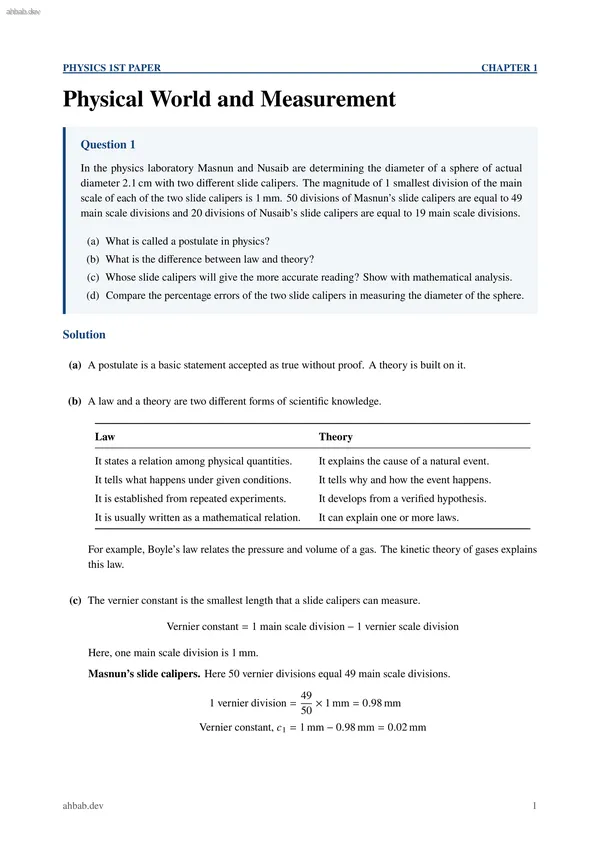
PHYSICS 1ST PAPER CHAPTER 1 Physical World and Measurement Question 1 In the physics laboratory Masnun and Nusaib are determining the diameter of a sphere of actual diameter 2.1 cm with two different slide calipers. The magnitude of 1 smallest division of the main scale of each of the two slide calipers is 1 mm. 50 divisions of Masnun’s slide calipers are equal to 49 main scale divisions and 20 divisions of Nusaib’s slide calipers are equal to 19 main scale divisions. (a) What is called a postulate in physics? (b) What is the difference between law and theory? (c) Whose slide calipers will give the more accurate reading? Show with mathematical analysis. (d) Compare the percentage errors of the two slide calipers in measuring the diameter of the sphere. Solution (a) A postulate is a basic statement accepted as true without proof. A theory is built on it. (b) A law and a theory are two different forms of scientific knowledge. Law Theory It states a relation among physical quantities. It explains the cause of a natural event. It tells what happens under given conditions. It tells why and how the event happens. It is established from repeated experiments. It develops from a verified hy
Nusaib’s slide calipers. Here 20 vernier divisions equal 19 main scale divisions. 1 vernier division = 19 20 × 1 mm = 0.95 mm Vernier constant, 𝑐2 = 1 mm −0.95 mm = 0.05 mm 0 5 10 15 20 mm Main scale 0 5 10 15 20 Vernier scale 19 main scale divisions = 19 mm 20 vernier divisions The figure shows the scale of Nusaib. Each vernier division is 0.05 mm shorter than a main scale division. Here 𝑐1 < 𝑐2. A smaller vernier constant gives a finer reading. Masnun’s slide calipers give the more accurate reading. (d) The largest possible error of a reading equals the vernier constant. Percentage error = vernier constant measured length × 100% The diameter of the sphere is 𝐷= 2.1 cm = 21 mm. For Masnun, 𝛿1 = 0.02 21 × 100% = 0.095% For Nusaib, 𝛿2 = 0.05 21 × 100% = 0.238% 𝛿2 𝛿1 = 0.05 0.02 = 2.5 The percentage error of Nusaib is 2.5 times that of Masnun. Both errors are below 1%. Hence both readings are acceptable. However, the reading of Masnun stays closer to the actual diameter. 𝛿1 = 0.095%, 𝛿2 = 0.238%, 𝛿2 = 2.5 𝛿1 ahbab.dev 2
Question 2 To determine the acceleration due to gravity with a simple pendulum, Nasib used the equation 𝑔= 4𝜋2𝐿 𝑇2 . In the experiment Nasib observed that 𝐿= (100 ± 0.1) cm and 𝑇= 2.1 s. The time for 20 oscillations was determined, where the precision was 1 s. (a) What is observation? (b) Explain with an example what a hypothesis is. (c) What was the percentage error of Nasib in determining the value of 𝑔? (d) In determining 𝑔, which quantity is to be measured with the highest care? Explain. Solution (a) Observation is the careful study of a natural event with the senses or instruments. (b) A hypothesis is a reasonable assumption made to explain an observed event. It has no experimental proof at first. Scientists test it by experiments. A verified hypothesis becomes a law or a theory. Example: Avogadro assumed a relation between the volume and the number of molecules of a gas. He stated that equal volumes of all gases contain equal numbers of molecules. The temperature and pressure must be the same. This statement was a hypothesis at that time. Later experiments verified it. It is now known as Avogadro’s law. (c) Here, Length of the pendulum 𝐿= 100 cm Error in the length Δ𝐿= 0.1 cm
10 further pages require an access key.
The pages above are free to read. The rest of this document is available to people holding a key issued by the author.