HSC Resources · Physics Homework Notes
Ch04 Newtonian Mechanics
Lecture slides and notes for Ch04 Newtonian Mechanics from the Physics Homework Notes module in HSC Resources by Md Ahbab. 14 pages.
Content Preview
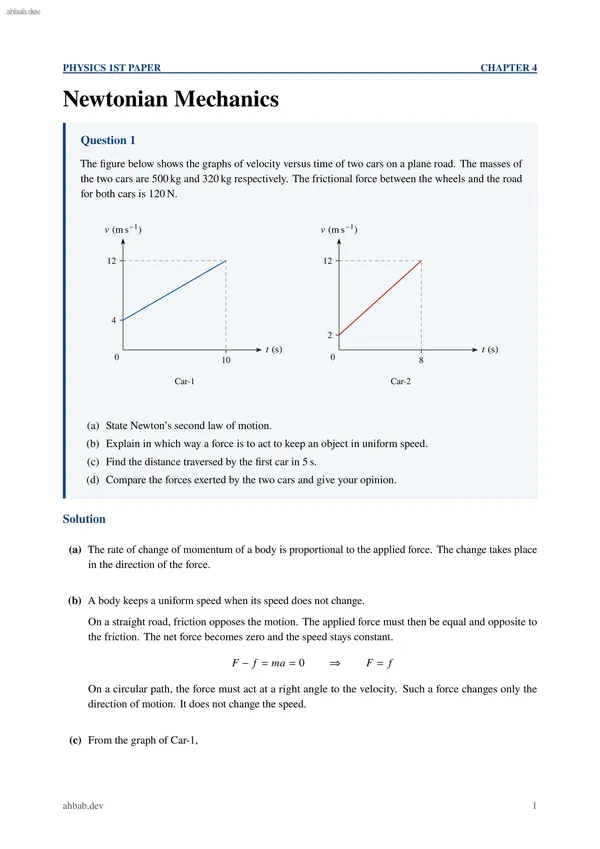
PHYSICS 1ST PAPER CHAPTER 4 Newtonian Mechanics Question 1 The figure below shows the graphs of velocity versus time of two cars on a plane road. The masses of the two cars are 500 kg and 320 kg respectively. The frictional force between the wheels and the road for both cars is 120 N. 𝑡(s) 𝑣(m s−1) 0 10 4 12 Car-1 𝑡(s) 𝑣(m s−1) 0 8 2 12 Car-2 (a) State Newton’s second law of motion. (b) Explain in which way a force is to act to keep an object in uniform speed. (c) Find the distance traversed by the first car in 5 s. (d) Compare the forces exerted by the two cars and give your opinion. Solution (a) The rate of change of momentum of a body is proportional to the applied force. The change takes place in the direction of the force. (b) A body keeps a uniform speed when its speed does not change. On a straight road, friction opposes the motion. The applied force must then be equal and opposite to the friction. The net force becomes zero and the speed stays constant. 𝐹−𝑓= 𝑚𝑎= 0 ⇒ 𝐹= 𝑓 On a circular path, the force must act at a right angle to the velocity. Such a force changes only the direction of motion. It does not change the speed. (c) From the graph of Car-1, ahbab.dev 1
Initial velocity 𝑢1 = 4 m s−1 Velocity after 10 s 𝑣1 = 12 m s−1 Required time 𝑡= 5 s The graph is a straight line. Hence the acceleration is uniform. It equals the slope of the line. 𝑎1 = 𝑣1 −𝑢1 𝑡1 = 12 −4 10 m s−2 = 0.8 m s−2 The distance covered in 5 s is 𝑠= 𝑢1𝑡+ 1 2𝑎1𝑡2 = 4 × 5 m + 1 2 × 0.8 × (5)2 m = 20 m + 10 m = 30 m 𝑠= 30 m (d) The engine force 𝐹acts forward on each car. The friction 𝑓= 120 N acts backward. 𝐹 𝑓 𝑎 The net force gives the acceleration. From Newton’s second law, 𝐹−𝑓= 𝑚𝑎 ⇒ 𝐹= 𝑚𝑎+ 𝑓 Car-1. Here 𝑚1 = 500 kg and 𝑎1 = 0.8 m s−2. 𝐹1 = 500 × 0.8 N + 120 N = 400 N + 120 N = 520 N Car-2. From the graph, the velocity rises from 2 m s−1 to 12 m s−1 in 8 s. 𝑎2 = 12 −2 8 m s−2 = 1.25 m s−2 𝐹2 = 320 × 1.25 N + 120 N = 400 N + 120 N = 520 N 𝐹1 = 𝐹2 = 520 N Both cars exert the same force. The second car has the smaller mass. Therefore, the same force gives it the greater acceleration. ahbab.dev 2
Question 2 Two swimmers of masses 40 kg and 70 kg stand at the two opposite sides of a floating stationary raft of mass 200 kg. Each of the swimmers dives from the raft at the same time with 4 m s−1 horizontal velocity. (a) What do you mean by impulse of force? (b) Why does a gun recoil when a bullet is fired? (c) Deduce the law of conservation of momentum. (d) Show with mathematical analysis that the raft will move with 0.6 m s−1 velocity towards which the swimmer of mass 40 kg dives. Solution (a) The product of a force and its time of action is called impulse of force. (b) The gun and the bullet are at rest before firing. Their total momentum is zero. The firing forces are internal forces. Hence the total momentum stays zero after firing. The bullet gains a forward momentum. The gun must gain an equal backward momentum. 𝑀𝑉+ 𝑚𝑣= 0 ⇒ 𝑉= −𝑚𝑣 𝑀 Here 𝑀and 𝑉belong to the gun, and 𝑚and 𝑣to the bullet. The negative sign shows the backward motion of the gun. This motion is the recoil. (c) Let two bodies of masses 𝑚1 and 𝑚2 move along one line. Their velocities are 𝑢1 and 𝑢2 before a collision. Their velocities are 𝑣1 and 𝑣2 after it. The collision lasts for a time 𝑡. 𝑚1 𝑚2 𝑢1 𝑢2 Before th
11 further pages require an access key.
The pages above are free to read. The rest of this document is available to people holding a key issued by the author.