HSC Resources · Physics Homework Notes
Ch02 Vector
Lecture slides and notes for Ch02 Vector from the Physics Homework Notes module in HSC Resources by Md Ahbab. 16 pages.
Content Preview
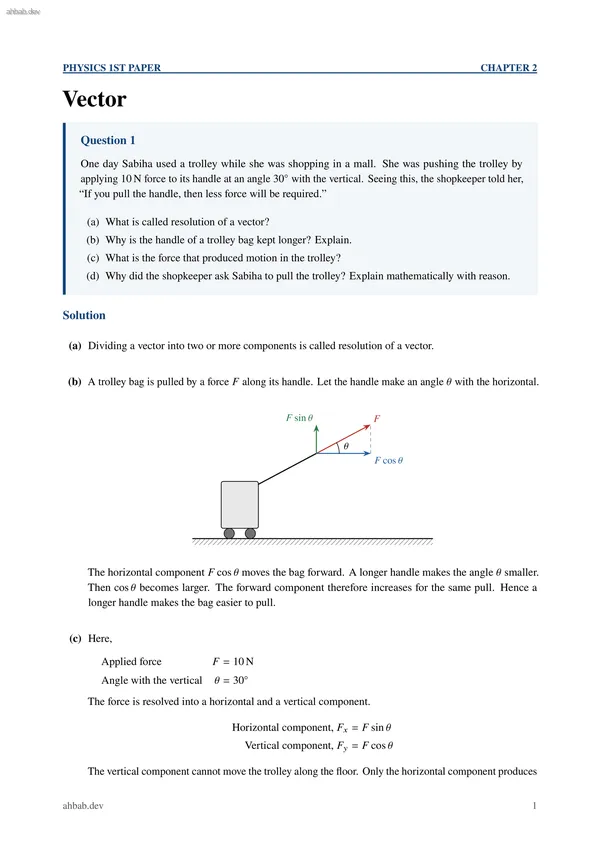
PHYSICS 1ST PAPER CHAPTER 2 Vector Question 1 One day Sabiha used a trolley while she was shopping in a mall. She was pushing the trolley by applying 10 N force to its handle at an angle 30◦with the vertical. Seeing this, the shopkeeper told her, “If you pull the handle, then less force will be required.” (a) What is called resolution of a vector? (b) Why is the handle of a trolley bag kept longer? Explain. (c) What is the force that produced motion in the trolley? (d) Why did the shopkeeper ask Sabiha to pull the trolley? Explain mathematically with reason. Solution (a) Dividing a vector into two or more components is called resolution of a vector. (b) A trolley bag is pulled by a force 𝐹along its handle. Let the handle make an angle 𝜃with the horizontal. 𝐹 𝐹cos 𝜃 𝐹sin 𝜃 𝜃 The horizontal component 𝐹cos 𝜃moves the bag forward. A longer handle makes the angle 𝜃smaller. Then cos 𝜃becomes larger. The forward component therefore increases for the same pull. Hence a longer handle makes the bag easier to pull. (c) Here, Applied force 𝐹= 10 N Angle with the vertical 𝜃= 30◦ The force is resolved into a horizontal and a vertical component. Horizontal component, 𝐹𝑥= 𝐹sin 𝜃 Vertical component
the motion. 𝐹𝑥= 𝐹sin 𝜃 = 10 N × sin 30◦ = 5 N 𝐹𝑥= 5 N (d) Let the weight of the trolley be 𝑊. The vertical component of the applied force is 𝐹𝑦= 𝐹cos 𝜃= 10 N × cos 30◦= 8.66 N 𝐹 30◦ 𝐹sin 𝜃 𝐹cos 𝜃 𝑊 𝑁1 Pushing: 𝑁1 = 𝑊+ 𝐹cos 𝜃 𝐹 𝐹cos 𝜃30◦ 𝐹sin 𝜃 𝑊 𝑁2 Pulling: 𝑁2 = 𝑊−𝐹cos 𝜃 Pushing. The force acts forward and downward along the handle. Its vertical component acts downward and adds to the weight. 𝑁1 = 𝑊+ 𝐹cos 𝜃= 𝑊+ 8.66 N Pulling. The force acts forward and upward along the handle. Its vertical component acts upward and opposes the weight. 𝑁2 = 𝑊−𝐹cos 𝜃= 𝑊−8.66 N Here 𝑁1 and 𝑁2 are the normal reactions of the floor. The friction on the wheels is proportional to the normal reaction. 𝑓= 𝜇𝑁 𝑓1 −𝑓2 = 𝜇(𝑁1 −𝑁2) = 2𝜇𝐹cos 𝜃= 17.32 𝜇N The forward component is 5 N in both cases. The friction is smaller in pulling. Hence the net forward force is larger in pulling. 𝑁2 < 𝑁1 ⇒ 𝑓2 < 𝑓1 The trolley therefore moves with less applied force when it is pulled. This is the reason for the advice of the shopkeeper. ahbab.dev 2
Question 2 Two boatmen Karim and Rahim are pulling a static boat of mass 500 kg in steady water by ropes with a force ®𝐹making angle 30◦from two banks as shown in the figure. The boat travels 3.6 km parallel to the bank in 5 minutes. Karim says to Rahim, “It is possible to reach this distance in less than 5 minutes with the same force.” [Neglect the frictional force between water and the boat surface.] River bank River bank Rahim Karim 𝜃= 30◦ 𝜃= 30◦ 3.6 km (a) What is a resultant vector? (b) Explain the benefit of using a much longer rope when pulling a boat. (c) Find the magnitude of the ®𝐹of the stem. (d) Give your opinion by analysing mathematically whether the statement of Karim is correct or not. Solution (a) A single vector equivalent to several vectors acting together is called their resultant. (b) A boat is pulled from the bank by a rope. Let the pull be 𝐹and its angle with the bank be 𝜃. puller on the bank 𝐹 𝐹cos 𝜃 𝐹sin 𝜃 𝜃 The component 𝐹cos 𝜃moves the boat forward. The component 𝐹sin 𝜃pulls the boat towards the bank. A longer rope makes the angle 𝜃smaller. Then 𝐹cos 𝜃increases and 𝐹sin 𝜃decreases. Hence the boat moves forward faster and drifts less towards the bank. ahba
13 further pages require an access key.
The pages above are free to read. The rest of this document is available to people holding a key issued by the author.