Code to Cloud · Notes
14 — Identity, Access, Payments & Third Party Integration
Lecture slides and notes for 14 — Identity, Access, Payments & Third Party Integration from the Notes module in Code to Cloud by Md Ahbab. 14 pages.
Content Preview
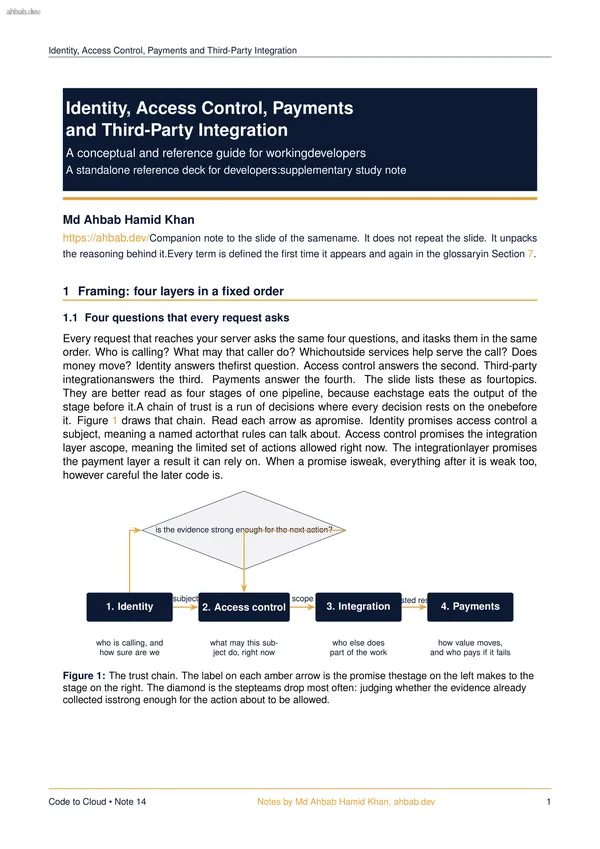
Identity, Access Control, Payments and Third-Party Integration Identity, Access Control, Payments and Third-Party Integration A conceptual and reference guide for workingdevelopers A standalone reference deck for developers:supplementary study note Md Ahbab Hamid Khan https://ahbab.dev/Companion note to the slide of the samename. It does not repeat the slide. It unpacks the reasoning behind it.Every term is defined the first time it appears and again in the glossaryin Section 7. 1 Framing: four layers in a fixed order 1.1 Four questions that every request asks Every request that reaches your server asks the same four questions, and itasks them in the same order. Who is calling? What may that caller do? Whichoutside services help serve the call? Does money move? Identity answers thefirst question. Access control answers the second. Third-party integrationanswers the third. Payments answer the fourth. The slide lists these as fourtopics. They are better read as four stages of one pipeline, because eachstage eats the output of the stage before it.A chain of trust is a run of decisions where every decision rests on the onebefore it. Figure 1 draws that chain. Read each arrow as apromis
Identity, Access Control, Payments and Third-Party Integration 1.2 Why the order is not arbitrary Swap any pair of layers and the design stops making sense. Access controlbefore identity has nothing to decide about, because a rule needs a subject.Integration before access control means you call a partner without knowingwhether the caller was allowed to trigger that call, so the partner bill andthe partner side effects are open to anyone. Payments before the other threemeans money moves on the word of an unknown caller. The order runs from thecheapest mistake to the most expensive one. A wrong login costs a supportticket. A wrong permission costs a data leak. A wrong integration costs anoutage. A wrong payment costs cash, and cash losses arrive with fees on top.There is a second reason for the order. Each layer needs a smaller and moreprecise input than the one before it. Identity turns a crowd into one person.Access control turns one person into a short list of allowed actions.Integration turns an allowed action into a set of calls with limitedauthority. Payments turn one of those calls into a movement of money thatcan be audited later. Information narrows at every step. If a step
Identity, Access Control, Payments and Third-Party Integration Table 1: Skipped layers and their delayed bills. The middle column mattersmost: the symptom shows up far from the cause, so teams often patch thesymptom and leave the missing layer missing. Layer skipped Shortcut taken instead First symptom inproduction Typical cost when it fails Identity Shared logins, or one long-lived API key pasted into the code Nobody can say which person performed an action No audit trail, so thesize of a breach cannot be measured and every account must be reset Access control Any logged-in user is treated the same One customeropens another customer’s record by changing a number in the URL Disclosure notices, refunds, and the loss of the largest accounts Integration hygiene Direct calls with no timeout, no retry plan and nofallback One slow partner freezes your own checkout A full outagecaused by a system you do not control and cannot fix Payment discipline The client sends the amount and the server trusts it Orders ship although no money was ever captured Direct cash loss, plusdispute fees, plus staff time per case the evidence is tosteal at scale, how much work it costs you to ship and support,
Other Documents in Notes
- 1 — Software Architecture & System Design
- 2 — Backend Engineering Across Frameworks
- 3 — Frontend Engineering & the Browser Layer
- 4 — Databases, Storage & the Data Layer
- 5 — AI Integration, Model Serving & Agentic Systems
- 6 — Containers, Docker & Kubernetes
- 7 — Cloud Infrastructure, VMs & Server Operating Systems
- 8 — Networking, Domains, TLS, CDN & Security