Code to Cloud · Notes
7 — Cloud Infrastructure, VMs & Server Operating Systems
Lecture slides and notes for 7 — Cloud Infrastructure, VMs & Server Operating Systems from the Notes module in Code to Cloud by Md Ahbab. 12 pages.
Content Preview
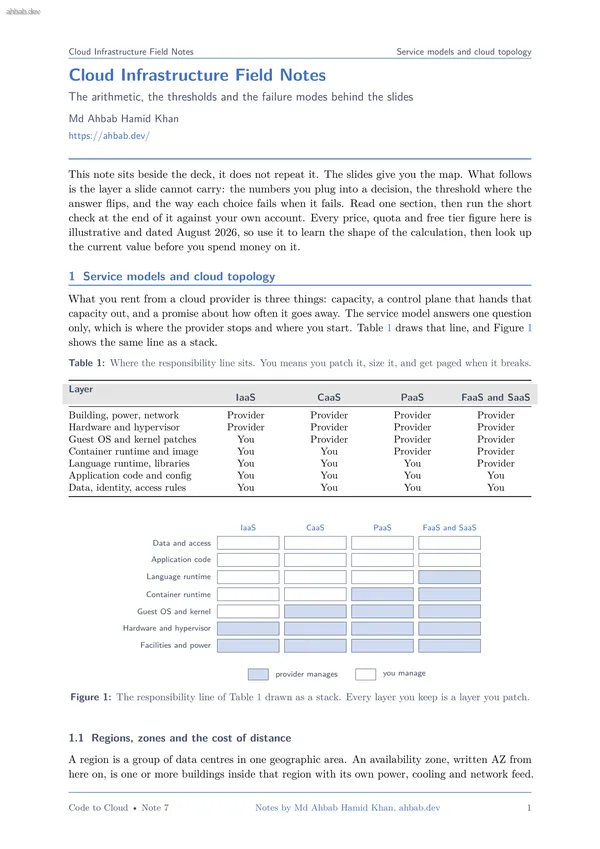
Cloud Infrastructure Field Notes Service models and cloud topology Cloud Infrastructure Field Notes The arithmetic, the thresholds and the failure modes behind the slides Md Ahbab Hamid Khan https://ahbab.dev/ This note sits beside the deck, it does not repeat it. The slides give you the map. What follows is the layer a slide cannot carry: the numbers you plug into a decision, the threshold where the answer flips, and the way each choice fails when it fails. Read one section, then run the short check at the end of it against your own account. Every price, quota and free tier figure here is illustrative and dated August 2026, so use it to learn the shape of the calculation, then look up the current value before you spend money on it. 1 Service models and cloud topology What you rent from a cloud provider is three things: capacity, a control plane that hands that capacity out, and a promise about how often it goes away. The service model answers one question only, which is where the provider stops and where you start. Table 1 draws that line, and Figure 1 shows the same line as a stack. Table 1: Where the responsibility line sits. You means you patch it, size it, and get paged when i
Cloud Infrastructure Field Notes Shared versus dedicated compute Two AZs fail independently. Two racks in one AZ do not. Figure 2 shows the shape to copy for a normal web service.Distance is the part engineers underestimate. Illustrative round trip times between two small virtual machines: inside one AZ, 0.2 to 0.5 ms; across AZs in one region, 0.5 to 2 ms; across regions on different continents, 70 to 160 ms. Now price a request that makes 40 sequential database calls. Move the database to another AZ and you add 40 x 1 ms = 40 ms. Move it to another continent and you add 40 x 70 ms = 2800 ms. A faster network never fixes this. Fewer round trips does. AZ a web and app private subnet AZ b web and app private subnet AZ c database standby replica Load balancer, regional 1 ms Region eu-west-1 Second region us-east-1 async copy 70 to 160 ms Figure 2: Two AZs for uptime, a third for the database quorum, a second region only for disaster recovery. The orange path is too slow to sit inside a user request. 1.2 Picking the layer Pick the highest layer that still meets your constraint. Drop a layer only when something forces it: a kernel module, a licence rule, an audit that wants disk level
Cloud Infrastructure Field Notes AWS, GCP and Azure side by side 2.1 Burst credits, with the arithmetic A burstable instance is sold with a baseline share of a vCPU, for example 20 percent. It earns credits while it runs below baseline and spends them when it runs above. One credit buys one vCPU-minute at full speed. Illustrative numbers for a 2 vCPU burstable with a 20 percent baseline: it earns 2 x 0.20 x 60 = 24 credits per hour, and it can bank at most 24 hours of accrual, so 576 credits.Now test a real workload. A nightly job that pins both vCPUs for 30 minutes spends 2 x 30 = 60 credits. At 24 credits per hour you need 2.5 idle hours to earn that back, which is fine once a night. Run the same job every hour and you spend 24 x 60 = 1440 credits a day against 576 earned. The balance reaches zero, the instance drops to baseline, and every job after that takes five times longer. Figure 3 shows both cases. 0 2 4 6 8 10 12 14 16 18 20 22 24 0 200 400 600 Hours since the instance started Credit balance Mostly idle, earns 24 credits per hour Hourly job, balance empties and the CPU is throttled Accrual cap, 576 credits Figure 3: Credit balance over one day. Once the orange line touche
Other Documents in Notes
- 1 — Software Architecture & System Design
- 2 — Backend Engineering Across Frameworks
- 3 — Frontend Engineering & the Browser Layer
- 4 — Databases, Storage & the Data Layer
- 5 — AI Integration, Model Serving & Agentic Systems
- 6 — Containers, Docker & Kubernetes
- 8 — Networking, Domains, TLS, CDN & Security
- 9 — CICD, Deployment Workflows & Observability