HSC Resources · Chemistry Homework Notes
Ch05 Vocational Chemistry
Lecture slides and notes for Ch05 Vocational Chemistry from the Chemistry Homework Notes module in HSC Resources by Md Ahbab. 12 pages.
Content Preview
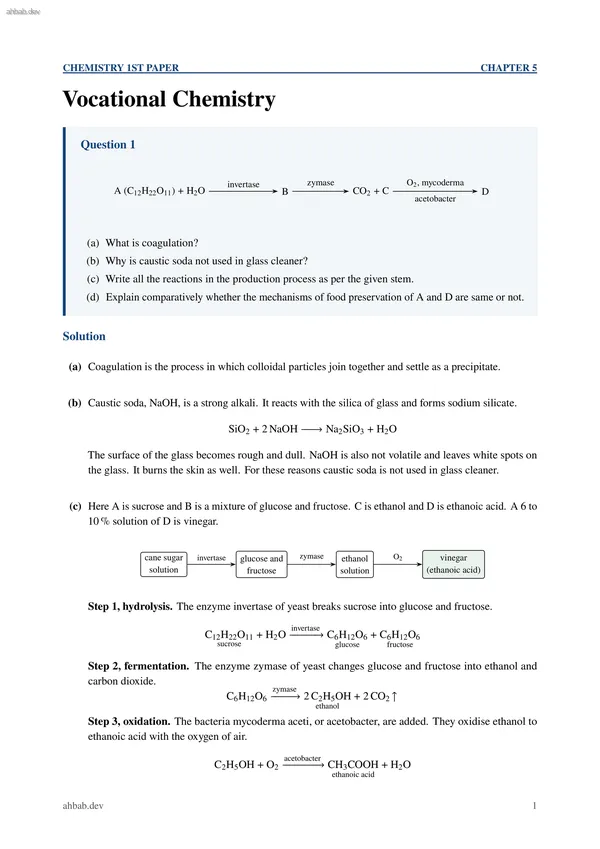
CHEMISTRY 1ST PAPER CHAPTER 5 Vocational Chemistry Question 1 A (C12H22O11) + H2O B CO2 + C D invertase zymase O2, mycoderma acetobacter (a) What is coagulation? (b) Why is caustic soda not used in glass cleaner? (c) Write all the reactions in the production process as per the given stem. (d) Explain comparatively whether the mechanisms of food preservation of A and D are same or not. Solution (a) Coagulation is the process in which colloidal particles join together and settle as a precipitate. (b) Caustic soda, NaOH, is a strong alkali. It reacts with the silica of glass and forms sodium silicate. SiO2 + 2 NaOH −−−→Na2SiO3 + H2O The surface of the glass becomes rough and dull. NaOH is also not volatile and leaves white spots on the glass. It burns the skin as well. For these reasons caustic soda is not used in glass cleaner. (c) Here A is sucrose and B is a mixture of glucose and fructose. C is ethanol and D is ethanoic acid. A 6 to 10 % solution of D is vinegar. cane sugar solution glucose and fructose ethanol solution vinegar (ethanoic acid) invertase zymase O2 Step 1, hydrolysis. The enzyme invertase of yeast breaks sucrose into glucose and fructose. C12H22O11 sucrose + H2O inv
(d) A is sugar and D is vinegar. Both preserve food, but their mechanisms are not the same. Mechanism of A. Sugar is used as a concentrated solution, as in jam and jelly. The solution outside a microbial cell is more concentrated than the liquid inside it. By osmosis, water moves out of the cell. The cell shrinks and cannot grow. The sugar also binds the free water of the food. Microorganisms cannot live without this water. Mechanism of D. Vinegar is an acid. It lowers the pH of the food below 4.5. CH3COOH −−−⇀ ↽−−−CH3COO−+ H+ Most bacteria cannot grow in such an acidic medium. The unionised CH3COOH molecules also enter the microbial cell. They ionise inside the cell and lower its pH. The enzymes of the cell lose their activity, and the cell dies. cell water moves out A: concentrated sugar solution H+ CH3COOH moves in D: vinegar Point A, sugar D, vinegar Nature neutral compound weak acid Action removes water by osmosis lowers the pH Type of change physical chemical Concentration used very high, above 60% low, 6 to 10 % Used in jam, jelly, fruits in syrup pickles, sauce, chutney Hence the mechanisms of food preservation of A and D are not the same. ahbab.dev 2
Question 2 (i) C2H5OH + O2 acetobacter −−−−−−−−→A + H2O (ii) CH3COCH3 + [O] K2Cr2O7 −−−−−−−−−−→ H2SO4 (conc.) A + CO2 + H2O (a) What is pH scale? (b) Explain how UV rays can detect a fake currency note. (c) Explain the mechanism of the compound A as food preservative. (d) Which chemical reaction is most favourable for the environment to produce the compound A? Analyse with mathematical atom economy. Solution (a) The pH scale is a scale from 0 to 14 for acidity of a solution. (b) A real note is printed on special paper with fluorescent security marks. These marks are invisible in ordinary light. Under a UV lamp the marks absorb UV rays and emit visible light. Hence they glow in fixed colours and positions. A fake note has no such marks, or its whole paper glows. In this way the note is identified. (c) Compound A is ethanoic acid, CH3COOH. Its 6 to 10 % aqueous solution is vinegar. Low pH of the food. Ethanoic acid ionises partly in water and gives H+ ions. CH3COOH −−−⇀ ↽−−−CH3COO−+ H+ The pH of the food falls below 4.5. Most bacteria grow only between pH 6.5 and 7.5. Hence they cannot grow in the food. Action inside the cell. The unionised CH3COOH molecules pass through the cell mem
9 further pages require an access key.
The pages above are free to read. The rest of this document is available to people holding a key issued by the author.