HSC Resources · Chemistry Homework Notes
Ch03 Periodic Properties of Elements and Chemical Bonding
Lecture slides and notes for Ch03 Periodic Properties of Elements and Chemical Bonding from the Chemistry Homework Notes module in HSC Resources by Md Ahbab. 14 pages.
Content Preview
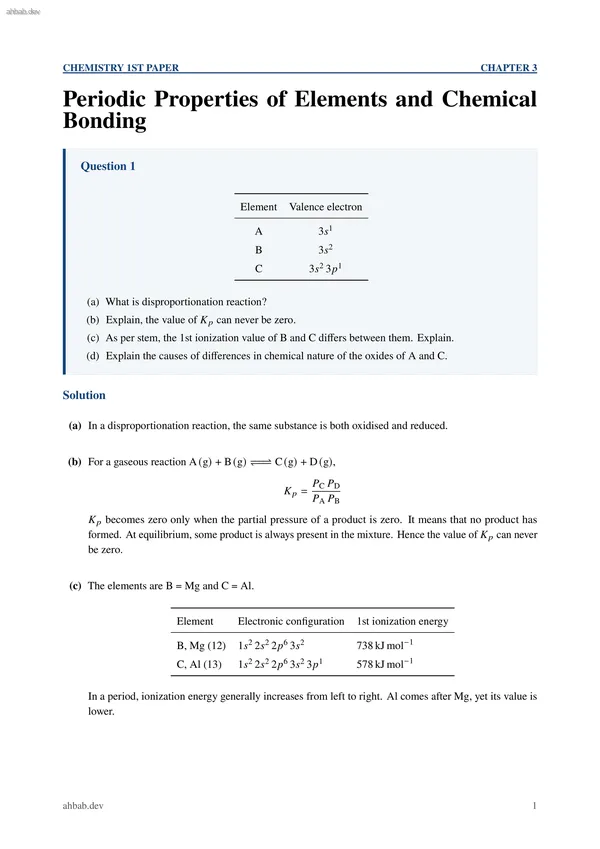
CHEMISTRY 1ST PAPER CHAPTER 3 Periodic Properties of Elements and Chemical Bonding Question 1 Element Valence electron A 3𝑠1 B 3𝑠2 C 3𝑠2 3𝑝1 (a) What is disproportionation reaction? (b) Explain, the value of 𝐾𝑝can never be zero. (c) As per stem, the 1st ionization value of B and C differs between them. Explain. (d) Explain the causes of differences in chemical nature of the oxides of A and C. Solution (a) In a disproportionation reaction, the same substance is both oxidised and reduced. (b) For a gaseous reaction A(g) + B(g) −−−⇀ ↽−−−C(g) + D(g), 𝐾𝑝= 𝑃C 𝑃D 𝑃A 𝑃B 𝐾𝑝becomes zero only when the partial pressure of a product is zero. It means that no product has formed. At equilibrium, some product is always present in the mixture. Hence the value of 𝐾𝑝can never be zero. (c) The elements are B = Mg and C = Al. Element Electronic configuration 1st ionization energy B, Mg (12) 1𝑠2 2𝑠2 2𝑝6 3𝑠2 738 kJ mol−1 C, Al (13) 1𝑠2 2𝑠2 2𝑝6 3𝑠2 3𝑝1 578 kJ mol−1 In a period, ionization energy generally increases from left to right. Al comes after Mg, yet its value is lower. ahbab.dev 1
1st ionization energy (kJ mol−1) 496 Na 738 Mg 578 Al In Mg, the outer electrons are in the completely filled 3𝑠orbital. This arrangement is stable. A 3𝑠 electron is also close to the nucleus. In Al, the outer electron is in the 3𝑝orbital. A 3𝑝orbital has higher energy than the 3𝑠orbital. The two 3𝑠electrons shield this electron from the nucleus. Hence the nucleus holds it weakly, and less energy removes it. Therefore the 1st ionization energy of B is greater than that of C. (d) The elements are A = Na and C = Al. Their oxides are Na2O and Al2O3. Oxide of A. Na2O is a strongly basic oxide. It forms an alkali with water and a salt with an acid. Na2O + H2O −−−→2 NaOH Na2O + 2 HCl −−−→2 NaCl + H2O Oxide of C. Al2O3 is an amphoteric oxide. It reacts with both an acid and an alkali. Al2O3 + 6 HCl −−−→2 AlCl3 + 3 H2O Al2O3 + 2 NaOH −−−→2 NaAlO2 + H2O Causes of the difference. Property Na Al Charge of the ion +1 +3 Ionic radius 102 pm 54 pm Electronegativity 0.9 1.5 The Na+ ion is large and has a low charge. The electronegativity difference between Na and O is large. Hence Na2O is highly ionic. Its O2– ion accepts protons easily. This oxide is therefore strongly basic. The Al3+ ion is sma
Question 2 Period Group-1 Group-17 2nd period X 3rd period P Y 4th period Z (a) What is buffer solution? (b) Heat of neutralisation of NaOH and HCl is constant. Explain. (c) Electron affinity of Y of the given stem is more than that of X. Explain. (d) Between PY and PZ compounds, which is more ionic? Explain. Solution (a) A buffer solution is a solution that resists a change of pH. Its pH stays almost constant when a little acid or base is added. (b) NaOH is a strong base and HCl is a strong acid. Both of them ionise completely in dilute solution. Na+ + OH−+ H+ + Cl−−−−→Na+ + Cl−+ H2O The Na+ and Cl– ions take no part in the reaction. The real change is the formation of water. H+(aq) + OH−(aq) −−−→H2O(l) Δ𝐻= −57.34 kJ mol−1 One mole of water forms in each case. Hence the heat of neutralisation is constant. (c) X is fluorine and Y is chlorine. Both belong to group 17. Element Valence shell Electron affinity X, F (9) 2𝑠2 2𝑝5 328 kJ mol−1 Y, Cl (17) 3𝑠2 3𝑝5 349 kJ mol−1 Electron affinity normally decreases down a group. Fluorine is an exception. F 𝑒− small 2𝑝shell strong repulsion Cl 𝑒− larger 3𝑝shell weak repulsion ahbab.dev 3
11 further pages require an access key.
The pages above are free to read. The rest of this document is available to people holding a key issued by the author.