HSC Resources · Chemistry Homework Notes
Ch02 Qualitative Chemistry
Lecture slides and notes for Ch02 Qualitative Chemistry from the Chemistry Homework Notes module in HSC Resources by Md Ahbab. 14 pages.
Content Preview
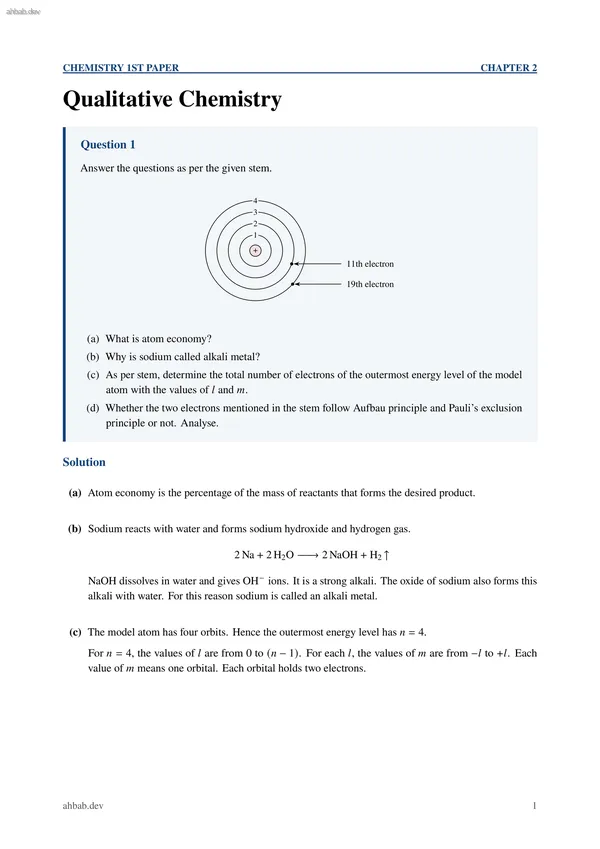
CHEMISTRY 1ST PAPER CHAPTER 2 Qualitative Chemistry Question 1 Answer the questions as per the given stem. 1 2 3 4 + 11th electron 19th electron (a) What is atom economy? (b) Why is sodium called alkali metal? (c) As per stem, determine the total number of electrons of the outermost energy level of the model atom with the values of 𝑙and 𝑚. (d) Whether the two electrons mentioned in the stem follow Aufbau principle and Pauli’s exclusion principle or not. Analyse. Solution (a) Atom economy is the percentage of the mass of reactants that forms the desired product. (b) Sodium reacts with water and forms sodium hydroxide and hydrogen gas. 2 Na + 2 H2O −−−→2 NaOH + H2 ↑ NaOH dissolves in water and gives OH– ions. It is a strong alkali. The oxide of sodium also forms this alkali with water. For this reason sodium is called an alkali metal. (c) The model atom has four orbits. Hence the outermost energy level has 𝑛= 4. For 𝑛= 4, the values of 𝑙are from 0 to (𝑛−1). For each 𝑙, the values of 𝑚are from −𝑙to +𝑙. Each value of 𝑚means one orbital. Each orbital holds two electrons. ahbab.dev 1
𝑙 Sub-shell Values of 𝑚 Orbitals Electrons 0 4𝑠 0 1 2 1 4𝑝 −1, 0, +1 3 6 2 4𝑑 −2, −1, 0, +1, +2 5 10 3 4 𝑓 −3, −2, −1, 0, +1, +2, +3 7 14 Total 16 32 Total orbitals = 𝑛2 = 42 = 16 Total electrons = 2𝑛2 = 2 × 42 = 32 Total electrons in the outermost energy level = 32 (d) Aufbau principle. Electrons enter the orbitals in the order of increasing energy. The orbital with the lower value of (𝑛+ 𝑙) has the lower energy. For equal values, the orbital with the lower 𝑛is filled first. Orbital 3𝑠 3𝑝 4𝑠 3𝑑 𝑛+ 𝑙 3 + 0 = 3 3 + 1 = 4 4 + 0 = 4 3 + 2 = 5 The first 10 electrons fill 1𝑠2 2𝑠2 2𝑝6. The next orbital of lowest energy is 3𝑠. Hence the 11th electron enters the 3rd orbit. The first 18 electrons fill up to 3𝑠2 3𝑝6. The value of (𝑛+ 𝑙) is 4 for 4𝑠and 5 for 3𝑑. Hence the 19th electron enters 4𝑠in the 4th orbit. The stem shows the same positions. energy 3𝑠 3𝑝 4𝑠 3𝑑 11th electron in sodium 19th electron in potassium empty Pauli’s exclusion principle. No two electrons of an atom have the same set of four quantum numbers. Electron Orbital 𝑛 𝑙 𝑚 𝑠 11th 3𝑠 3 0 0 + 1 2 19th 4𝑠 4 0 0 + 1 2 Each of them is the first electron of its orbital. No other electron of the atom has the same four values. Henc
Question 2 Answer the questions as per the stem. 𝑛= 1 𝑛= 2 𝑛= 3 𝑛= 4 + Jump-A Jump-B 𝑅𝐻= 1.09678 × 10⁻² nm−1 ℎ= 6.626 × 10⁻³⁴ J s (a) What is common ion effect? (b) At 25 ◦C pH of pure water is 7. Explain. (c) Calculate the speed of the electron in the last orbit having radius 8.5 × 10⁻⁸ cm. (d) Explain mathematically which spectrum produced from Jump-A and Jump-B will be visible. Solution (a) A strong electrolyte with a common ion lowers the dissociation of a weak electrolyte. This is called the common ion effect. (b) Pure water ionises to a very small extent. H2O −−−⇀ ↽−−−H+ + OH− At 25 ◦C the ionic product of water is 𝐾𝑤= 1.0 × 10⁻¹⁴. Pure water gives equal numbers of H+ and OH– ions. [H+] [OH−] = 1.0 × 10⁻¹⁴ [H+]2 = 1.0 × 10⁻¹⁴ [H+] = 1.0 × 10⁻⁷ M pH = −log[H+] = −log(1.0 × 10⁻⁷) = 7 Hence the pH of pure water is 7 at 25 ◦C. (c) Here, Number of the last orbit 𝑛= 4 Radius of the orbit 𝑟= 8.5 × 10⁻⁸ cm = 8.5 × 10⁻¹⁰ m Planck’s constant ℎ= 6.626 × 10⁻³⁴ J s Mass of an electron 𝑚= 9.11 × 10⁻³¹ kg ahbab.dev 3
11 further pages require an access key.
The pages above are free to read. The rest of this document is available to people holding a key issued by the author.