HSC Resources · Physics Homework Notes
Physics 1 ch1
Physics 1 Chapter 1 practise question and solves
Content Preview
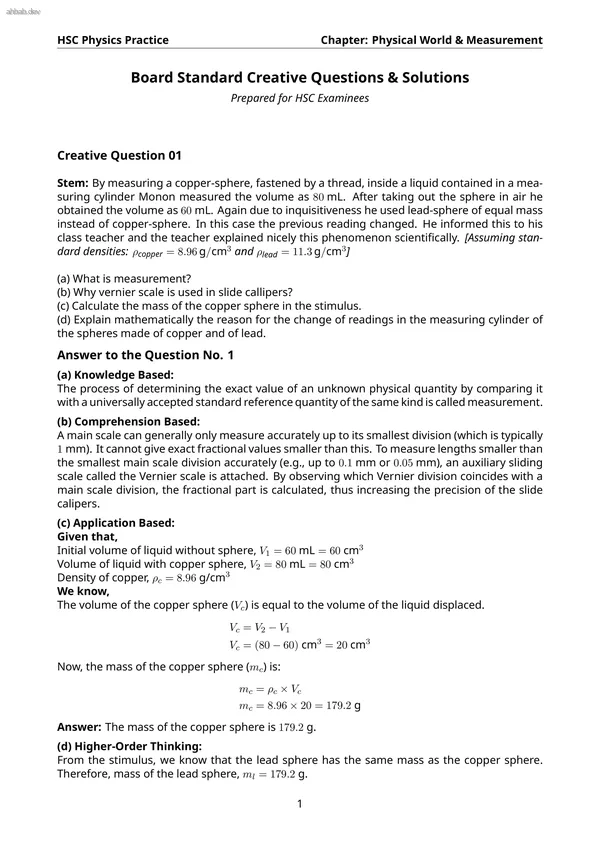
HSC Physics Practice Chapter: Physical World & Measurement Board Standard Creative Questions & Solutions Prepared for HSC Examinees Creative Question 01 Stem: By measuring a copper-sphere, fastened by a thread, inside a liquid contained in a mea- suring cylinder Monon measured the volume as 80 mL. After taking out the sphere in air he obtained the volume as 60 mL. Again due to inquisitiveness he used lead-sphere of equal mass instead of copper-sphere. In this case the previous reading changed. He informed this to his class teacher and the teacher explained nicely this phenomenon scientifically. [Assuming stan- dard densities: ρcopper = 8.96 g/cm3 and ρlead = 11.3 g/cm3] (a) What is measurement? (b) Why vernier scale is used in slide callipers? (c) Calculate the mass of the copper sphere in the stimulus. (d) Explain mathematically the reason for the change of readings in the measuring cylinder of the spheres made of copper and of lead. Answer to the Question No. 1 (a) Knowledge Based: The process of determining the exact value of an unknown physical quantity by comparing it with a universally accepted standard reference quantity of the same kind is called measurement. (b) Comprehens
HSC Physics Practice Chapter: Physical World & Measurement Given, Mass of lead sphere, ml = 179.2 g Density of lead, ρl = 11.3 g/cm3 Initial volume of liquid, V1 = 60 mL Mathematical Analysis: The volume of the lead sphere (Vl) can be calculated as: Vl = ml ρl Vl = 179.2 11.3 cm3 ≈15.86 cm3 (or mL) When the lead sphere is submerged, the new reading in the measuring cylinder will be the sum of the initial volume and the volume of the lead sphere: New Reading = V1 + Vl = 60 + 15.86 = 75.86 mL Conclusion: Even though the mass of both spheres is the same, lead has a higher density than copper (ρl > ρc). According to the relation V = m/ρ, for a constant mass, volume is inversely proportional to density. Thus, the lead sphere has a smaller volume than the copper sphere (15.86 cm3 < 20 cm3). Because the lead sphere displaces less liquid than the copper sphere, the final vol- ume reading changes (drops) from 80 mL to 75.86 mL. This mathematical difference in density correctly justifies the teacher’s explanation. 2
HSC Physics Practice Chapter: Physical World & Measurement Creative Question 02 Stem: In practical class of physics the teacher gave you a piece of metal sphere and asked to measure the radius of curvature by a spherometer. The distance between the two legs of the spherometer that you used was 8 cm. During measuring the mass by oscillation method a mass of 10 g was placed on the right pan and if the difference of the two fixed points was found 30, then answer the following questions. (a) What is vernier constant? (b) Distinguish between fundamental quantity and derived quantity. (c) What is the radius of curvature of the piece of the sphere if the height of the curved surface is 1.1 cm above the three legs of the spherometer? (d) If the change of the fixed points of the index needle is 8 for additional mass of 10 g, then find the actual mass of the body. Answer to the Question No. 2 (a) Knowledge Based: Vernier constant (VC) is the difference between the length of one smallest main scale division and one vernier scale division. It is the minimum length that can be measured accurately using a vernier scale. (b) Comprehension Based: Fundamental Quantity Derived Quantity 1. The physic
6 further pages require an access key.
The pages above are free to read. The rest of this document is available to people holding a key issued by the author.