HSC Resources · Chemistry Homework
Chemistry 1 Ch 1 note and homework
Lecture slides and notes for Chemistry 1 Ch 1 note and homework from the Chemistry Homework module in HSC Resources by Md Ahbab. 29 pages.
Content Preview
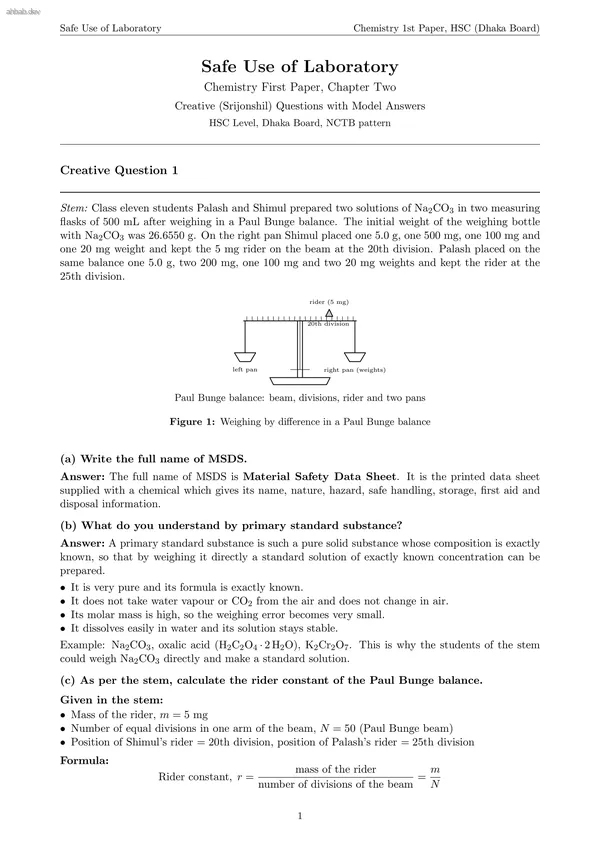
Safe Use of Laboratory Chemistry 1st Paper, HSC (Dhaka Board) Safe Use of Laboratory Chemistry First Paper, Chapter Two Creative (Srijonshil) Questions with Model Answers HSC Level, Dhaka Board, NCTB pattern Creative Question 1 Stem: Class eleven students Palash and Shimul prepared two solutions of Na2CO3 in two measuring flasks of 500 mL after weighing in a Paul Bunge balance. The initial weight of the weighing bottle with Na2CO3 was 26.6550 g. On the right pan Shimul placed one 5.0 g, one 500 mg, one 100 mg and one 20 mg weight and kept the 5 mg rider on the beam at the 20th division. Palash placed on the same balance one 5.0 g, two 200 mg, one 100 mg and two 20 mg weights and kept the rider at the 25th division. rider (5 mg) 20th division left pan right pan (weights) Paul Bunge balance: beam, divisions, rider and two pans Figure 1: Weighing by difference in a Paul Bunge balance (a) Write the full name of MSDS. Answer: The full name of MSDS is Material Safety Data Sheet. It is the printed data sheet supplied with a chemical which gives its name, nature, hazard, safe handling, storage, first aid and disposal information. (b) What do you understand by primary standard substance? An
Safe Use of Laboratory Chemistry 1st Paper, HSC (Dhaka Board) Step 1: Putting the values, r = 5 mg 50 = 0.1 mg per division = 1 × 10⁻⁴ g per division Step 2: So the mass shown by the rider is mrider = (division number) × r For Shimul: 20 × 0.1 = 2.0 mg = 0.0020 g. For Palash: 25 × 0.1 = 2.5 mg = 0.0025 g. Comment: The rider constant of this balance is 0.1 mg per division, that is 1 × 10⁻⁴ g. Because of the rider a mass smaller than the smallest weight (10 mg) can be measured without touching the pan. (d) Show mathematically whose solution of the two students will have higher concen- tration. Answer: The mass of Na2CO3 taken is found by the weighing by difference method: w = (initial mass of bottle + Na2CO3) −(final mass of the bottle) Step 1: Total weights on the right pan Shimul = 5.0 + 0.500 + 0.100 + 0.020 = 5.620 g Palash = 5.0 + (2 × 0.200) + 0.100 + (2 × 0.020) = 5.540 g Step 2: Mass shown by the rider (rider constant = 0.1 mg per division) Shimul = 20 × 0.1 = 2.0 mg = 0.0020 g; Palash = 25 × 0.1 = 2.5 mg = 0.0025 g Step 3: Final mass of the weighing bottle Shimul = 5.620 + 0.0020 = 5.6220 g; Palash = 5.540 + 0.0025 = 5.5425 g Step 4: Mass of Na2CO3 taken wS = 26.6550 −5.6220
Safe Use of Laboratory Chemistry 1st Paper, HSC (Dhaka Board) Comment: Since 0.3983 > 0.3968, the solution of Palash is more concentrated. The reason is simple: the final mass of Palash’s weighing bottle was smaller, so he poured out more Na2CO3 into the same 500 mL flask. Creative Question 2 Stem: Two apparatus of the laboratory are shown below. 0 10 20 30 40 Fig. 1 : Burette 10 20 30 40 Fig. 2 : Measuring cylinder Figure 2: Apparatus of Question 2 (a) What is rider constant? Answer: The mass which is shown by one division of the beam of a Paul Bunge balance when the rider is placed on it is called the rider constant. For a 5 mg rider and a beam of 50 divisions, rider constant = 5/50 = 0.1 mg per division. (b) What do you understand by secondary standard substance? Answer: A secondary standard substance is such a substance whose solution of exactly known concentration cannot be made by direct weighing, because the substance is not fully pure or it changes in air. First an approximate solution is made and then its exact concentration is found by titrating it against a primary standard solution. NaOH takes water vapour and CO2 from air, so it is a secondary standard. HCl, KMnO4 and
25 further pages require an access key.
The pages above are free to read. The rest of this document is available to people holding a key issued by the author.